
COTTON & CANVAS · SIZE DEVELOPMENT
A cotton cosmetic bag can meet its delivery dimensions and still become unsuitable for the intended contents after washing. For a beauty brand developing a pouch that is intended to be washed, “allow for shrinkage” leaves an important question unanswered: which dimensions must remain usable, at which stage, and under which agreed care procedure?
Specify the delivered bag and the post-wash bag as two states of the same design. Identify the measurement points, define the intended contents, and review a representative finished sample against both sets of requirements. A fabric shrinkage percentage can inform development; it cannot, on its own, approve the size of a lined, sewn cosmetic bag.
This guide addresses cotton pouch size development, not whether any pictured Rivta product is washable. Start with the custom canvas and cotton cosmetic bag route when the fabric and finished dimensions are the main sourcing decisions.

Write two size requirements before choosing an allowance
The first requirement concerns the bag as supplied: its presentation, nominal dimensions, usable opening and fit within the agreed packaging. The second concerns the same design after the specified washing and drying sequence: the useful space and closure must still suit the intended contents. Neither requirement should be left to a general “standard tolerance.”
A pouch made larger to preserve post-wash capacity might no longer fit its paper sleeve or retail carton before washing. Conversely, a pouch that looks neat in its delivered packaging might have little spare room around a rigid compact. Resolve both constraints before treating extra fabric as the solution.
| State or decision | What to specify | What the record should show |
|---|---|---|
| As supplied | Named external dimensions and tolerances, opening, intended contents and packaging fit. | Sample revision, marked measurement locations and delivered-state observations. |
| After the agreed care sequence | Minimum usable fit, relevant dimension limits and acceptable closure/shape. | The same sample locations, the completed procedure and a fresh fit check after drying. |
| Pattern or material adjustment | Which construction variable may change and which requirements stay fixed. | A revised development sample; an allowance is not an approval result. |
Make the measurement drawing more specific than W × H × D
Mark the points on the selected construction
A tapered pouch can have different widths at the zipper and the base. A rounded body may have no sharp corner from which to start a tape measurement. For each dimension, put a letter on a drawing or sample photograph and define its endpoints. State whether the bag is empty, laid flat, standing in its normal shape or filled with the reference contents.
For example, a project drawing might call A the external width at the zipper seam, B the external body height from the agreed top seam to the base, and C the base depth between identified seam lines. Those labels are examples, not a universal bag measurement system. A different construction may need different points.
Keep the measuring condition repeatable. Pulling a soft bag taut on one occasion and letting it relax on another makes the numbers difficult to compare. Agree how to position the sample, whether the zipper is open or closed, and how the sample is prepared before each reading. For formal testing, the agreed laboratory procedure should govern specimen preparation and measurement.
Record usable fit separately from external size
External width does not describe the space between lining seams, and zipper length does not describe the opening through which a rigid product can pass. Record the intended contents with their actual packaging, caps and protruding parts. Confirm the loading orientation and whether every item must fit at once.
The post-wash review should repeat that same loading task. A bag that closes only when the buyer removes one item has changed the usable fit, even if its outer measurements remain within a selected tolerance. Do not solve this disagreement by comparing an external dimension with an internal requirement.
Tie every shrinkage figure to a defined washing and drying procedure
Ask what happened to the specimen before accepting a percentage. The public scope of ISO 6330:2021 describes domestic washing and drying procedures for textile testing1. Its summary makes clear that a complete test includes washing and drying, and that equipment and detergent parameters can affect results. The standard number alone is therefore not a complete project instruction.
Where this method is selected, agree the applicable procedure and edition with the supplier or laboratory. Identify the specimen, washing route, drying route, number of repetitions and preparation before measurement. If a buyer uses a different agreed method, identify it clearly rather than describing it as an ISO test. Do not compare a hand-washed, flat-dried sample with a machine-washed, tumble-dried sample as though only the fabric changed.
ISO 5077:2007 concerns dimensional change following specified washing and drying procedures2. Its public scope covers fabrics, garments and other textile articles. It does not supply a universal acceptable shrinkage percentage for a cosmetic bag. Set the project's dimension and functional acceptance criteria separately, using the full applicable procedure where a standards-based assessment is required.
These references support the distinction between the exposure procedure and the dimensional assessment. They are not instructions to wash the pictured products, and they do not establish that Rivta has tested them to either standard.
Read the results without turning them into a cutting rule
Keep the initial and final readings beside each other for each marked dimension. As ordinary percentage arithmetic, a signed dimensional change can be written as:
(after − before) ÷ before × 100%
A negative result indicates contraction; a positive result indicates expansion. This calculation illustrates how to read a change, not the full ISO specimen or measurement procedure.
Hypothetical arithmetic example — not Rivta test data. If one defined measurement is 200 mm before the agreed procedure and 194 mm afterwards, that measurement changed by −3%. The result does not mean every panel, the zipper opening or the internal capacity changed by 3%.
Review width and height independently. Record an unexpected increase as well as a decrease, and retain the individual sample readings rather than only a rounded headline percentage. Identify the number and selection of specimens in the agreed assessment plan; one development sample is evidence about that specimen, not a basis for claiming that every production unit will behave identically.
A measured change is an input to the pattern developer. It is not a direction to enlarge every cutting dimension by that percentage. Seam allowances, gusset geometry, lining dimensions and closure construction must remain coordinated. Ask the supplier to explain the proposed adjustment and make a revised sample while holding the agreed post-wash fit requirement fixed.
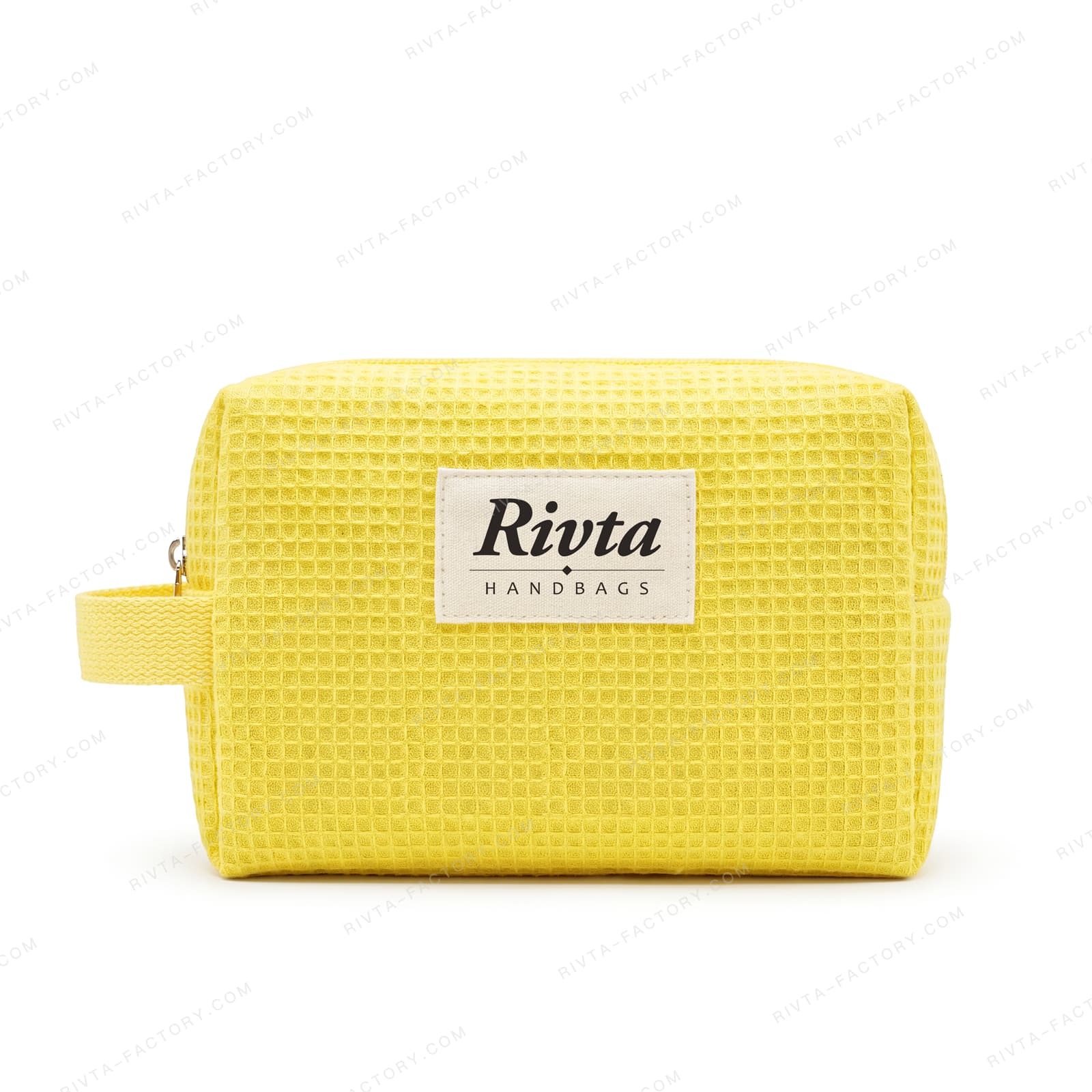
A fabric result cannot release a lined pouch
Use a swatch result to investigate the selected fabric, while keeping its material identity and finishing route attached to the result. Confirm whether the fabric was already processed in a way intended to control dimensional change, and whether the tested specimen represents the fabric intended for production. Do not substitute “cotton,” “canvas” or “pre-shrunk” for that information.
The finished sample adds other constraints. Check whether the lining sits smoothly, whether the zipper edge stays usable and whether the base still opens into the intended shape after the agreed procedure. If the outer shell contracts while the lining no longer sits as intended, inspect the combination rather than approving each component in isolation. This is a review question, not a prediction that a particular material combination will fail.
Use the measured endpoints to locate a problem. Did A change while the closure still works? Did the measured body stay acceptable while a lining fold obstructs a compact? Is the difficulty confined to the opening rather than the main cavity? Those observations point to different development decisions. “The bag shrank” is too broad to tell the supplier which requirement needs attention.
The canvas material and claim guide covers the earlier fabric-selection brief. Here, the decision is narrower: can the selected construction meet the delivered-state and post-wash fit requirements together? If the team changes the lining, size or closure after approval, use the sample-change review guide to identify which earlier decisions need confirmation again.
Send a two-state size brief to the supplier
Send one marked drawing with two clearly labelled sets of requirements: as supplied and after the agreed care sequence. Include the intended contents or a reference loading set, the packaging envelope, the material and lining route, and the assessment method. Leave unagreed limits visibly open for discussion; do not hide them behind “factory standard.”
A useful supplier response identifies the current sample revision, confirms how the dimensions will be measured, explains which proposed material or construction changes need sampling, and separates a development suggestion from a verified result. Ask for a revised sample if the two size states cannot yet be reconciled.
Release the dimensional decision only when the record identifies the selected sample, the procedure, the initial and final readings, the fit observations and the person approving the outcome. A dimensional pass alone does not approve other wash-related attributes such as colour or decoration durability; those remain separate requirements when relevant.
Review your cotton pouch size brief with Rivta
Send the marked dimensions, intended contents, supplied-state packaging limits and the post-wash fit you need. Include the proposed care procedure, material and lining preferences, quantity and launch timing. Rivta can review the development route and confirm which sample checks and project evidence need to be agreed.
Request a cotton pouch size review
For product and fabric options, return to canvas and cotton cosmetic bags.
Buyer questions
Can we use one shrinkage allowance for every bag dimension?
Do not assume a single percentage applies to every direction or component. Review defined dimensions separately, then ask the supplier to coordinate the pattern, lining, gusset and closure in a revised sample. Confirm both supplied-state packaging fit and post-wash usable fit.
Does a pre-shrunk fabric description remove the need for a finished-sample review?
No. Confirm what processing and evidence the description refers to, then review the selected finished construction against the agreed procedure and size requirements. The description alone does not establish the result for the lining, seams, opening or complete bag.
Sources and scope
The official public summaries below support the method distinctions in this guide. They do not replace the full procedures, set a bag acceptance limit or establish a Rivta product test result.
- ISO, ISO 6330:2021 — Domestic washing and drying procedures for textile testing: public scope on specified washing/drying routes and influential test parameters. ↩
- ISO, ISO 5077:2007 — Determination of dimensional change in washing and drying: public scope on dimensional assessment after specified procedures. ↩
About the Author

WRITTEN BY JOLIAN LU, SEO MANAGER
Hi there! I'm a mom to an awesome eleven-year-old boy. I started in this business as a fresh-faced graduate and now lead Rivta-Factory's SEO and content work. Here to share my passion for sustainability and building a business that cares. Let's grow together!
